Review: Gothic Lolita Dictionary

When I first heard about this book I was excited and expected it to be a nice little reference for Japanese words for different terms and maybe a little extra info. I was not expecting them to have gone as hard as they did for this book. If I had to pick a single reference book from my collection to recommend that would cover the most information about the history of lolita fashion, it would be this one. I actually started this review last year when this book first came out and just, never published it.
The book is approximately the size of a typical 8.5×11 sheet of paper folded in half, so about half the size of a gothic lolita bible, but it’s just shy of 200 pages long, so it’s not hurting for space inside. It’s worth noting that this is not a photobook, and you will need to read it to really appreciate it. While the edges of the page are decorated, it’s mostly black text (or red text) on matte cream paper and my google translate app had no trouble doing OCR and translation. The content is mostly grouped in bite-size chunks, so it’s easy to snap a quick photo in the translate app and get a relatively-OK translation. There are passages that are a little complex, and I would absolutely be onboard to buy a copy if they ever published it in English, but I was able to “read” enough of it with google translate to get general ideas.
The book opens with some guides on how to use the book including defining Gothic, Lolita and Gothic Lolita. Content throughout the book is tagged as Gothic, Lolita, or Gothic Lolita. This is different from a lot of English-Language resources where we don’t tend to separate Gothic Lolita from the rest of Lolita in this way.
It then goes on to have a brief history of “pre-lolita” fashion by time period and talks about how those eras influenced lolita fashion (I learned info I didn’t know here). It then goes into Lolita fashion and gothic lolita fashion, followed by a history of goth (mostly centered on 1980s-1990s), and introduces steampunk as a “brother” style to goth.
This is followed by short (2 pages) explanations of what Goth, Lolita and Gothic Lolita are. (I learned info I didn’t know here too). Next it moves into interviews with Mitsukazu Mihara and Mana. You get a little info about Mariko Suzuki in the process as she is the interviewer and compares her own experiences at times. (I learned new info here too). There is a then a 4-page spread about lace written with input from Asuka at Angelic Pretty and 4 Japanese Lace companies/retailers. You will learn things here. For example, I learned that Kobayashi Lace created the iconic MMM cross lace and that they were the first company to make custom gothic lolita lace for a brand.
Then we move into the dictionary proper. Pages 38-187 are all dictionary entries, with each entry being about a paragraph. It averages out to about 4-ish entries per page, so it covers a huge amount of information. About 80% of the entries are illustrated with what looks like inked colored pencil sketches by Hazegawa of Putumato, and a small handful have photographs.
If you don’t read Japanese, it’s not easy to browse. It’s alphabetical… in Japanese, and there are tabs, but you have to know the Japanese word for what you want to look up and how it fits into Japanese alphabetizing, and I don’t. It’s worth noting that even things like American & British names are often written in Japanese characters, so you really have to rely on the sketches to navigate if you can’t read the titles.
The variety of topics is delightful and comprehensive. It covers the basics that “everyone knows”, but it also throws in explanations of much more obscure cultural elements that are not well known (at least not in English-speaking lolita circles). It’s also incredibly fun to turn a page and suddenly be confronted with one of the entries on “western” gothic culture like a definition of who Ozzy Osbourne or Adora BatBrat is.
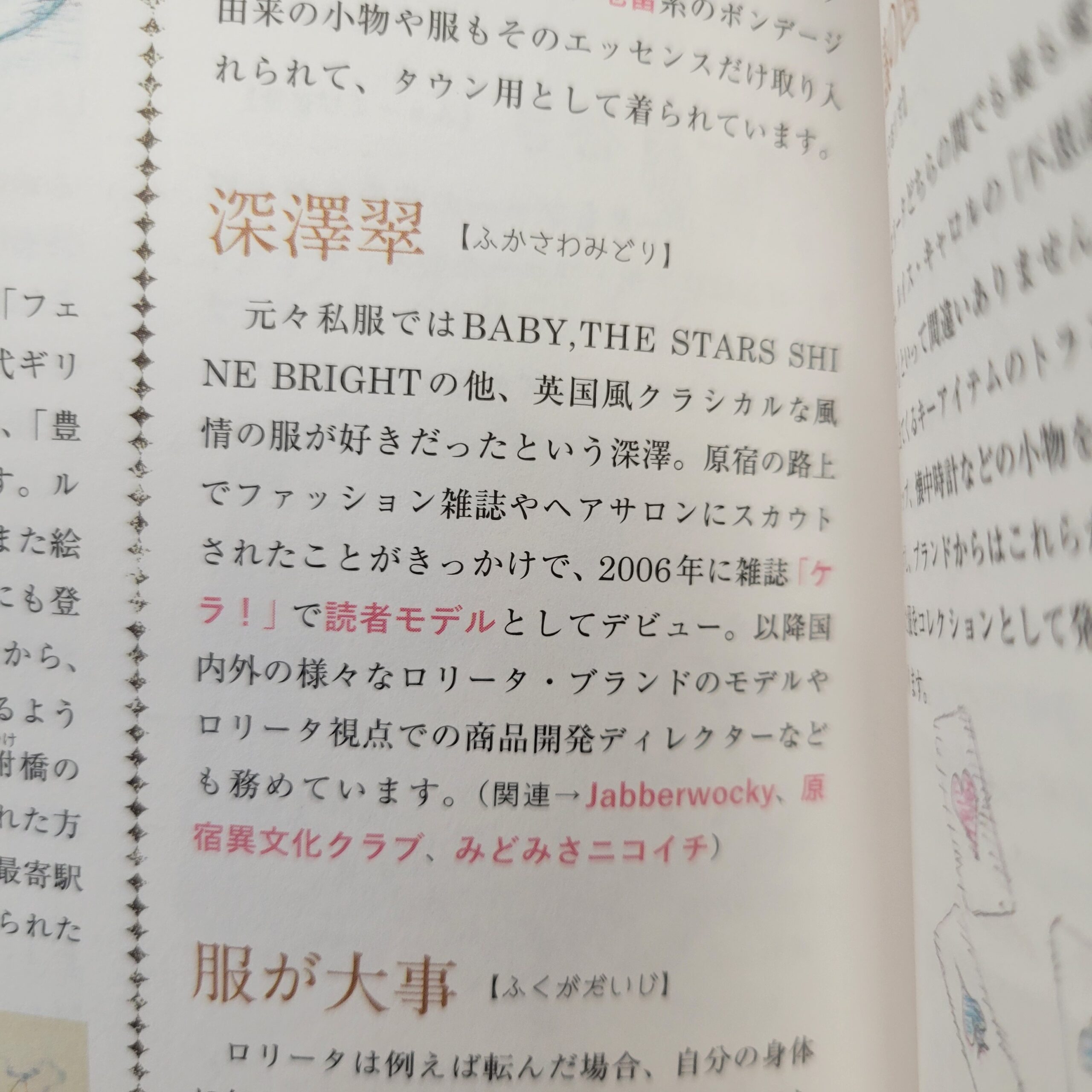
I haven’t gone through the whole book cover to cover in one sitting and it’s possible that I’ve just missed entries due to the titles all being fully in Japanese, but one thing that someone mentioned which I also noticed skimming through is that Baby/Pirates is conspicuously absent from the dictionary, as is Novala. Baby is mentioned in passing in the entry for Midori, but don’t have their own. Their name also isn’t in pink like other items in the dictionary are when they are mentioned in other entries. This is doubly weird because Pirates of the Caribbean is included as a nod to eye patches, and even much smaller brands are mentioned.
All in all, I think it’s a solid reference and I think it’s probably the most comprehensive and best lolita referece book I’ve had the pleasure of reading. It’s currently selling on Amazon Japan for 1,870 yen (~$13 USD) before shipping, which is a great price considering how much I used to spend just to get the latest GLB delivered to the US. You can also likely get it from Japanese book stores if you have one near you or want to use a shopping service.